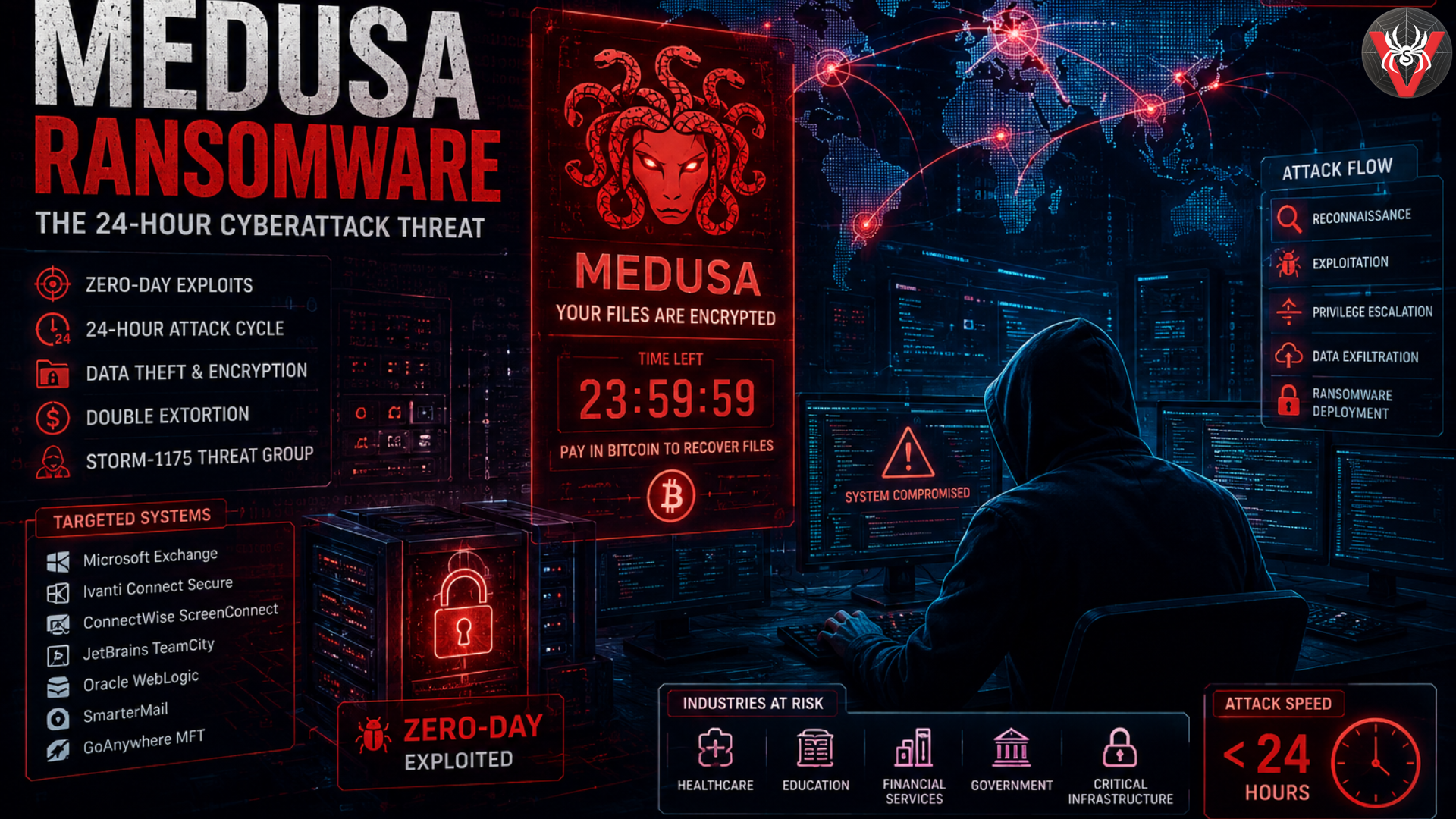
Cybersecurity threats are evolving faster than ever, and one ransomware group is currently alarming security experts worldwide — Medusa Ransomware. Unlike traditional ransomware attacks that may take days or weeks to unfold, Medusa-linked attackers are now compromising and encrypting systems in less than 24 hours using dangerous zero-day exploits.
This new generation of cyberattacks demonstrates how modern cybercriminals are combining automation, vulnerability scanning, and advanced hacking techniques to launch high-speed ransomware operations against businesses, hospitals, schools, and critical infrastructure.
What Is Medusa Ransomware?
Medusa Ransomware is a ransomware operation known for carrying out double-extortion attacks. In these attacks:
- Attackers first steal sensitive data
- Then encrypt the victim’s systems
- Finally demand payment to restore access and prevent data leaks
Recent investigations revealed that a threat group known as Storm-1175 has been linked to rapid Medusa ransomware campaigns targeting internet-facing systems.
What Makes These Attacks Different?
The biggest concern surrounding these attacks is the use of zero-day vulnerabilities.
A zero-day vulnerability is a software flaw that:
- Is unknown to the software vendor
- Or has no available patch at the time of attack
This means organizations may be compromised before they even realize the vulnerability exists.
Security researchers report that Medusa operators are exploiting newly discovered vulnerabilities extremely quickly — sometimes within hours of public disclosure.
How the Attack Works
A typical Medusa ransomware attack follows a highly aggressive and fast-moving process.
1. Internet-Wide Scanning
Attackers scan thousands of internet-facing servers searching for vulnerable systems.
2. Exploiting Vulnerabilities
Once a vulnerable target is identified, attackers exploit:
- Unpatched servers
- Weak remote access systems
- Zero-day vulnerabilities
3. Establishing Persistence
The attackers install tools that allow them to maintain access even if passwords are changed.
4. Credential Theft
Administrative credentials are stolen to gain deeper access into the organization’s network.
5. Data Exfiltration
Sensitive business data is copied before encryption begins.
6. Ransomware Deployment
The ransomware encrypts systems and files, causing severe operational disruption.
7. Extortion
Victims receive ransom demands requesting cryptocurrency payments in exchange for decryption and to prevent public data leaks.
Researchers say some organizations were fully compromised in under 24 hours.
Systems and Software Being Targeted
Attackers have reportedly targeted vulnerabilities in several widely used enterprise platforms, including:
- Microsoft Exchange
- Ivanti Connect Secure
- ConnectWise ScreenConnect
- JetBrains TeamCity
- Oracle WebLogic
- SmarterMail
- GoAnywhere MFT
These systems are commonly exposed to the internet, making them attractive targets for ransomware operators.
Industries at Highest Risk
Medusa ransomware campaigns have heavily targeted:
- Healthcare organizations
- Educational institutions
- Financial services
- Government agencies
- Critical infrastructure providers
Healthcare organizations are especially vulnerable because hospitals and emergency services cannot tolerate extended downtime, increasing pressure to pay ransom demands quickly.
Tools Used by the Attackers
Security analysts observed attackers using several advanced tools and techniques, including:
- PowerShell
- PsExec
- Impacket
- Web shells
- Remote monitoring tools
- “Living Off the Land” binaries (LOLBins)
These tools help attackers blend malicious activity with normal system operations, making detection more difficult.
Why Cybersecurity Experts Are Concerned
Traditional ransomware attacks often involve attackers remaining hidden inside networks for days or weeks before deploying encryption.
Medusa campaigns are far more dangerous because:
- Attacks are highly automated
- Vulnerabilities are weaponized rapidly
- Attack timelines are dramatically compressed
This leaves defenders with very little time to detect and respond.
Experts warn that the gap between vulnerability disclosure and active exploitation is shrinking from weeks to mere hours.
How Organizations Can Protect Themselves
Cybersecurity professionals recommend several defensive strategies to reduce ransomware risk.
Patch Systems Immediately
Critical vulnerabilities should be patched as quickly as possible.
Enable Multi-Factor Authentication (MFA)
MFA significantly reduces the risk of stolen credentials being abused.
Monitor Internet-Facing Assets
Organizations should continuously monitor exposed systems for suspicious activity.
Use Endpoint Detection and Response (EDR)
Modern EDR solutions can detect abnormal attacker behavior early.
Maintain Offline Backups
Offline backups help organizations recover without paying ransom demands.
Segment Networks
Network segmentation limits attacker movement within the environment.
Monitor Logs and Alerts
Early detection is essential against fast-moving ransomware attacks.
The Bigger Cybersecurity Problem
The Medusa ransomware campaigns represent a much larger shift in cybercrime, including:
- Faster attack execution
- AI-assisted automation
- Rapid exploit development
- More aggressive extortion tactics
Cybercriminal groups are becoming increasingly organized and technically advanced, making proactive cybersecurity more important than ever.
Organizations that delay updates, expose remote services, or lack proper monitoring are becoming easy targets for modern ransomware groups.
Final Thoughts
The rise of Medusa Ransomware highlights how dangerous modern cyber threats have become. With attackers exploiting vulnerabilities within hours and launching ransomware operations at record speed, businesses and institutions must strengthen their security posture immediately.
In today’s threat landscape, cybersecurity is no longer optional — it is a critical requirement for survival.
To understand and defend against advanced cyberattacks, gaining practical cybersecurity knowledge and real-world skills is becoming increasingly important. This is where SpidervellA offers its specialized cybersecurity training program, HackersvellA.
The program focuses on:
- Ethical hacking
- Penetration testing
- Vulnerability assessment
- Network security
- Real-world attack simulations
These hands-on learning experiences help students and professionals build strong defensive cybersecurity skills against evolving threats such as ransomware and zero-day exploits.
Whether you are a beginner or an aspiring cybersecurity professional, practical cybersecurity training can play a major role in understanding how attackers operate and how organizations can better defend themselves against modern cyber threats.
